Online Dietitian Guidance Platform for Japanese Medical Institutions
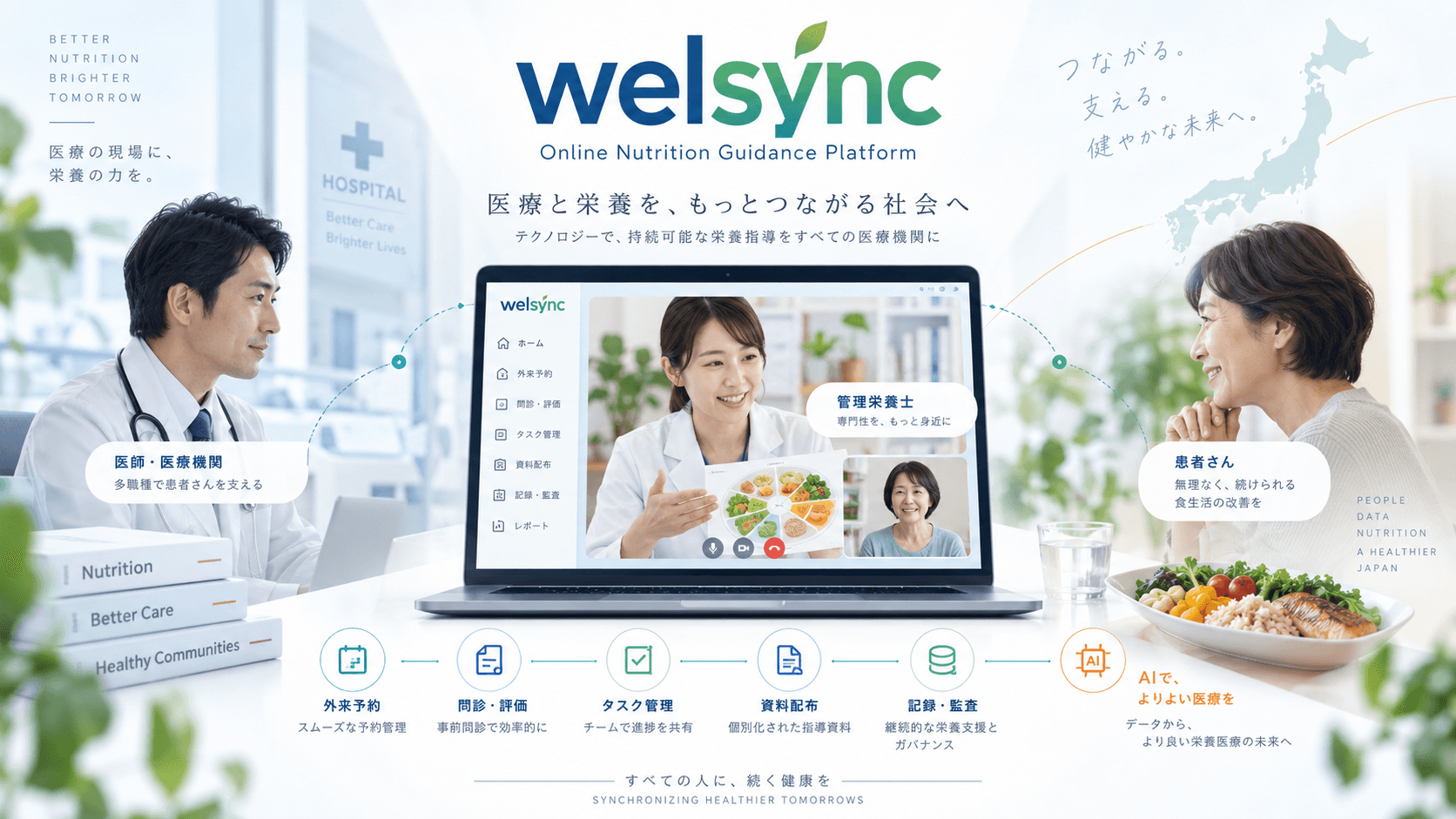
welsync is a digital nutrition guidance platform designed to connect medical institutions, registered dietitians, and patients within a single clinical and operational workflow for outpatient nutrition counseling in Japan. The project aims to systematize the full process from physician instructions, nutrition guidance plan creation, patient pre-interview questionnaires, online consultations, consultation records, electronic delivery of documents, medical institution review, work records, and settlement. Its goals are to establish an operational foundation that supports medical reimbursement requirements, optimize registered dietitian resource utilization, provide patient engagement through a unified patient portal, and enable workflow automation with auditable records.
[ TIMELINE ]
In Progress
[ CLIENT ]
OCTAWELL
[ INDUSTRY ]
Medical
[ CHALLENGE ]
Outpatient nutrition counseling in Japan is generally provided directly by registered dietitians working within medical institutions. However, many hospitals and clinics do not have enough dietitians to consistently meet demand, especially when consultation demand increases temporarily or becomes concentrated during specific time periods. At the same time, qualified dietitians are available outside hospitals, but simply connecting external dietitians to hospitals through online consultations is not enough to satisfy actual clinical workflows and medical reimbursement requirements.
The first challenge for welsync is to clearly record the relationship between physician instructions and the work performed by the registered dietitian. The project assumes a secondment-based operating model in which dietitians work under the direction of medical institutions. Therefore, the system must record who issued an instruction, when the dietitian reviewed it, when the consultation was conducted, and when the consultation record was shared back with the medical institution. A simple video consultation or appointment system cannot provide sufficient evidence of this operational structure.
The second challenge is to accurately generate and preserve the records required for medical reimbursement. For outpatient nutrition counseling, registered dietitians are required to prepare a nutrition guidance plan, preserve the relevant information in the medical record, and provide written documentation to the patient. In online consultations, documents cannot simply be handed to the patient in person. It therefore becomes important to keep system logs showing who created the plan, when it was created, when it was electronically delivered to the patient, and when it was reviewed by the medical institution. If these records are incomplete, administrative work increases and reimbursement claims may also become more difficult.
The third challenge is that the workflow between the medical institution, registered dietitian, and patient is highly fragmented. The full process may include appointment booking, pre-interview questionnaires, physician instructions, dietitian assignment, Zoom guidance, various consent forms, nutrition guidance plan creation, consultations, consultation records, follow-up reporting, patient status monitoring, medical institution confirmation, and settlement. If these processes are managed through separate tools such as email, phone calls, spreadsheets, Google Forms, Zoom, and Box, omissions and duplicate work are likely to occur, while the operational burden on staff increases significantly.
It is also important to maintain a simple patient experience. If patients are required to log into a new system every time and navigate through menus, dropout may increase. On the other hand, sending many separate and unrelated links by email and SMS makes it difficult for both patients and operations teams to manage the process. The system therefore needs a unified authentication and data foundation while still allowing patients to directly access the exact screen they need at each point in the process.
The fourth challenge is efficient utilization of registered dietitian resources. OCTAWELL already operates its existing service, welet, for Specific Health Guidance, while both welsync and welet rely on the same registered dietitian network, internally referred to as NTs. If the two services remain completely separate, available capacity in one service cannot easily be reassigned to work in the other. In the long term, NT availability, workload, skills, and tasks should therefore be managed across services in a unified way.
The fifth challenge is the need to support both insured and private-pay care models. Hospitals may operate outpatient nutrition counseling under the national reimbursement system, while clinics prescribing obesity treatment drugs may offer nutrition support as private-pay care because of facility requirements for insurance reimbursement. Although the core nutrition counseling workflow is similar, pricing, patient payment, consultation packages, frequency of consultations, and settlement methods may differ. The system should therefore not be tightly coupled to only one reimbursement model.
Finally, welsync is not intended to remain a standalone service forever. OCTAWELL already has a network of more than 5,000 registered dietitians and operates the existing welet business. Additional nutrition and health support services may also be introduced in the future. Therefore, rather than building an isolated system only for welsync, the architecture should be designed so that it can later evolve into a shared platform for users, dietitians, tasks, nutrition guidance history, and PHR data.
Ultimately, the core challenge of welsync is not simply to create an online nutrition consultation tool, but to build an operational infrastructure that connects physician instructions, dietitian work, patient engagement, reimbursement documentation, settlement, and resource allocation within the realities of the Japanese healthcare system.
[ SOLUTION ]
welsync is designed not as a simple Zoom-based nutrition consultation service, but as a platform that connects the entire nutrition counseling workflow between medical institutions, registered dietitians, and patients in one operational system. To achieve this, the project integrates patient engagement, physician instructions and approvals, dietitian task management, plan and consultation record generation, system logs, and settlement into one consistent workflow.
The first core component is a structured flow connecting physician instructions and dietitian activities. When a physician or medical institution staff member registers a patient-specific instruction, the assigned NT receives the instruction and the system records that it has been reviewed. The dietitian then prepares the nutrition guidance plan, conducts the actual consultation, and creates the consultation record. The medical institution can then review the completed documentation. The full process—from physician instruction to NT review, consultation, record sharing, and institutional confirmation—is recorded as a traceable workflow.
The second component is the systemization of nutrition guidance plan creation and delivery. For the first consultation, the system automatically creates a task for the assigned NT once the physician instruction and patient pre-interview questionnaire are both available. During the continuation phase, the trigger can be the availability of the latest physician instruction and the patient’s weekly report. A draft of the nutrition guidance plan can be generated from the questionnaire and clinical information provided by the medical institution, after which the dietitian reviews and edits it before finalization. The finalized plan is stored in the system, electronically delivered to the patient, and fully logged with timestamps for creation, review, and delivery.
The third component is a unified patient portal experience. Once the first appointment is confirmed, the patient receives a request to complete a pre-interview questionnaire through both email and SMS. Through the same patient portal foundation, the patient can complete the questionnaire and provide consent for personal information sharing, online counseling, Zoom recording, and electronic delivery of the nutrition guidance plan. Zoom access, plan viewing, and weekly reporting during the continuation phase are also managed through the same user foundation.
However, patients are not expected to log into the portal homepage and search through menus every time. Instead, the email or SMS message contains a deep link directly to the required screen, such as the Zoom session, questionnaire, or plan review page. This allows the underlying authentication and data layer to remain unified while keeping the patient journey simple.
The fourth component is automatic task creation and a dietitian work dashboard. The system automatically identifies operational states such as missing physician instructions, readiness to create a nutrition plan, upcoming consultations, missing consultation records, and pending medical institution review, then creates the necessary tasks. This reduces the need for the operations team to manually monitor every case and allows NTs to manage their own work from a single screen. In the future, tasks from welet can be integrated into the same structure so that NTs can manage work across multiple services from one dashboard.
The fifth component is integrated management of registered dietitian resources. welsync is designed to structure and manage NT availability, workload capacity, assigned patients, and appointment schedules. After integration with welet, unused NT capacity in one service can be reassigned to another. In the future, this can be extended to include each NT’s specialty, skills, training history, evaluation, and performance, enabling more appropriate assignment of dietitians to patients or services.
The sixth component is a flexible service model supporting both insured and private-pay care. The common core—appointments, patient information, NT assignment, consultations, and records—remains the same, while the system can distinguish whether a case is covered by insurance reimbursement or private-pay care from the beginning. Insurance-based care can apply the required reimbursement documentation and fee structure, while private-pay care can support more flexible offerings such as monthly counseling, counseling packages with chat support, or multiple pricing models. This makes it possible to expand beyond hospitals to clinics and other types of medical institutions.
The seventh component is a data structure designed for operations, settlement, and auditability. For every consultation, the system stores structured information such as the assigned NT, consultation duration, physician instructions, nutrition guidance plan, consultation record, patient delivery status, and medical institution review status. These records can be used not only for reimbursement and institutional confirmation, but also for settlement between OCTAWELL and medical institutions, calculation of NT compensation, and quality management. Important actions are stored in audit logs so that it is always possible to verify who performed what action and when.
The eighth component is a phased transition from PoC operations to full systemization. During the initial PoC stage, existing SaaS tools such as Google Forms and Zoom can be used to validate the operational process. Once the actual workflow has been confirmed, functions such as questionnaire distribution and collection, patient consent, plan delivery, task management, notifications, and record storage can gradually be integrated into welsync. This avoids overbuilding before the real requirements of the medical institution are fully understood.
The ninth component is an architecture designed for future expansion into an integrated platform. Instead of refactoring the existing welet system and attempting to tightly merge it with welsync, the proposed approach is to first build welsync on a cleaner architecture and later expand it into a shared platform for NT resources, tasks, participants, and nutrition guidance data. Necessary data from the existing welet system can then be migrated into the new platform.
This future integrated platform can manage common domains such as:
User profile and consent information
NT profile and available capacity
NT skills, training history, and evaluation
Service-specific tasks
Appointments and consultation history
Nutrition guidance plans and consultation records
Health, behavioral, and PHR data
Contract information for medical institutions, insurers, corporations, and individuals
On top of this shared platform, welsync, welet, and future nutrition-related services can each operate as separate branch services.
Technically, welsync combines Healthcare Workflow + Resource Management + Patient Engagement + Compliance-oriented Record Management. It is designed to go beyond basic appointment booking or video consultations and to support the full operational lifecycle required for nutrition guidance in medical institutions: physician instructions, patient questionnaires, work allocation, nutrition plans, consultations, records, confirmation, electronic delivery, and settlement.
Ultimately, welsync is not simply an online nutrition counseling SaaS product. It is a digital clinical and operational infrastructure that enables Japanese medical institutions to reliably deliver outpatient nutrition counseling by using an external network of registered dietitians. In the longer term, it is designed to evolve into a next-generation integrated nutrition guidance platform that combines welsync, welet, and future services, connects nutrition intervention history throughout the patient lifecycle, and optimizes the utilization of dietitian resources.
[ RESULTS ]
In Progress
Now